Reminder of problem:
Problem Statement: Given a 2-complex , find a 2-chain in the tetrahedralization of the unit cube that approximates .
The heuristic approach from 2025-10-10 did not appear to work. Below is an idea for an MIP approach.
Define
- = set of triangles in the unit cube
- = volume of triangle
- = set of sample points for
- subset of triangles in that “cover”
We use the following decision variables:
- - triangle is selected
- - sample is selected
Objective function:
To capture , we use the following constraint
Right now the concern is ensuring that selected triangles are connected. Perhaps we can make use of a dual graph and do network flow?
Define dual graph where each triangle is a node and is an edge if triangles and share an edge.
Introduce variable:
- - flow from to
Add two new constraints:
- Flow can only travel along edges if the destination is selected
In terms of a choice of , is an apt choice as there is at most 3 edges connecting each vertex.
- Flow conservation
Right now there is no incentive for to be positive. We can encourage it by changing the objective to maximize:
Typically in max flow problems, we are sending flow from a source node to a sink node. But in our case, we want the source and sink to be the same triangle.
Final MILP:
Of course, this problem is very dependent on choice of parameters.
One thing not yet tackled is how to define , i.e., which triangles “cover” a sample point. Below is a list of ideas on how to define it:
- Distance based
A sample point is covered by a triangle if the distance is less than some threshold value .
- Containment
A sample point is covered by a triangle if .
- Barycentric coordinates
For each tetrahedron, compute the barycentric coordinates of . is covered by a triangle if the corresponding has .
Alternative approach is to start with an isosurface and construct a cube that contains the faces of an isosurface. The idea:
- Divide the input space into a 3-complex
- Perform marching tetrahedra to reconstruct the isosurface as a 2-complex
- Use the 2-complex to cut the 3-complex for the input space
In other words, this is the new problem statement:
Problem Statement: Given an isosurface , construct a 2-chain approximating the isosurface that lies inside a 3-complex.
References:
- https://www.sciencedirect.com/science/article/abs/pii/0167839688900131
- https://ieeexplore.ieee.org/document/885704
- https://ieeexplore.ieee.org/document/1207437
- https://paulbourke.net/geometry/polygonise/
Marching Tetrahedra
We start with describing marching cubes. We divide the space into a 3D grid and sample our function for each vertex. For each grid cell, we create planar facets which best represent the isosurface through that grid cell. Using a threshold value, we look for pairs of vertices where one vertex is above the threshold and the other is below. There are 8 vertices of a grid cell, making combinations.
We encode each combination with a 8-bit index which is then used to lookup a list of edges (represented by 12-bits) specifying which edges of the cube are cut by the isosurface.
For instance, consider the image below where only vertex 3 is below the isosurface:
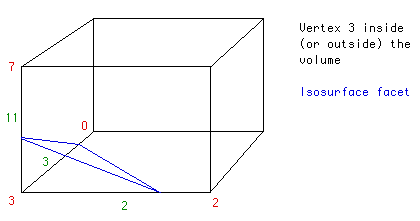
The combination would be given by 0000 1000. Looking up that value in edge table would give 1000 0000 1100 indicating that edges 2, 3 and 11 are cut by the isosurface. The intersection points are calculated by linear interpolation:
where and are the vertices of a cut edge.
We now switch to marching tetrahedra. Each grid cell of our 3-D grid is split into 6 tetrahedrons:
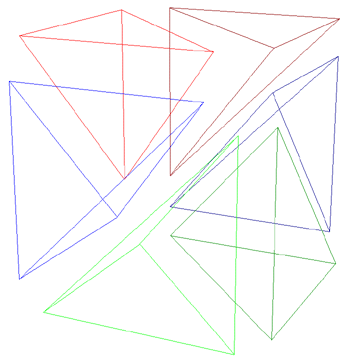
There are now only 4 vertices per tetrahedron. Leaving combinations. In other words, due to symmetry, there are only 8 cases for cutting the tetrahedra:
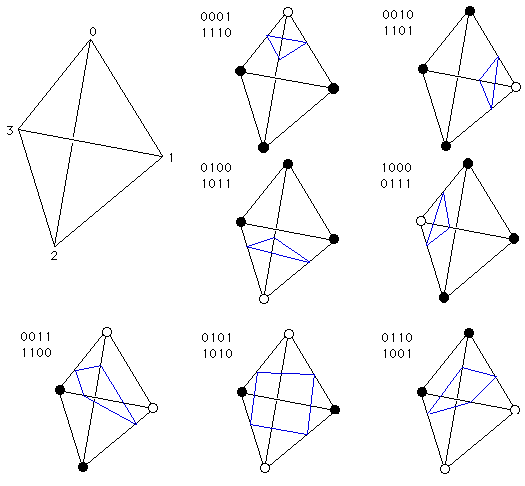
The 8th case (not listed above) is the one where all vertices are above or below the threshold.
Question: Can we pre-cut the tetrahedra so that we can simply mark the corresponding triangles?
Instead of linearly interpolating the points, we weaken the approximation by taking the midpoint. But I am unsure how pre-computing all the cuts would affect the complex. That is, will any of the triangles intersect non-neighboring triangles?
The tetrahedron with the corner cuts (only 1 differing vertex state) looks like the following (a D8 die):
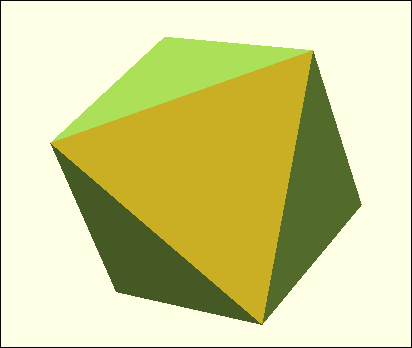
Ignoring the 2 vertex cuts at the moment, the idea would be to replace each tetrahedron with the 4 cut tetrahedra and a tetrahedralization of the above object. Then during the marching process just select the correct faces to be used in the 2-chain.
The two-vertex cuts have the following shape cut out:
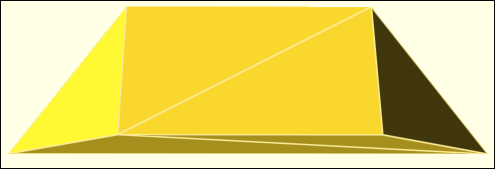
The final complex after all cuts is a single tetrahedron. No two non-adjacent of the triangles appear to intersect.
This leaves the following approach:
- For each tetrahedron in the space do the following:
- Subdivide the tetrahedron as described above (unclear on actual implementation of this)
- Determine what the combination of vertices (from original tetrahedron) is given by our isosurface .
- Lookup which triangles correspond to that combination and mark those triangles as part of the 2-chain.
Going to 4-D should work, except our grid would now be in 4-D resulting in more tetrahedra during the splitting process.