I was investigating the notion of torsion in relation to the flat norm LP as suggested by Bala’s conversation with Claude and I believe I came up with a counterexample.
I took a triangulation of , fattened it up by replacing each triangle of with a tetrahedra where the fourth point is given by the barycentric coordinates of the triangle. I then randomly generated input chains until I found one that gave fractional solutions. I set . I did not use the area of the triangles as weights, I simply set the weights to one.
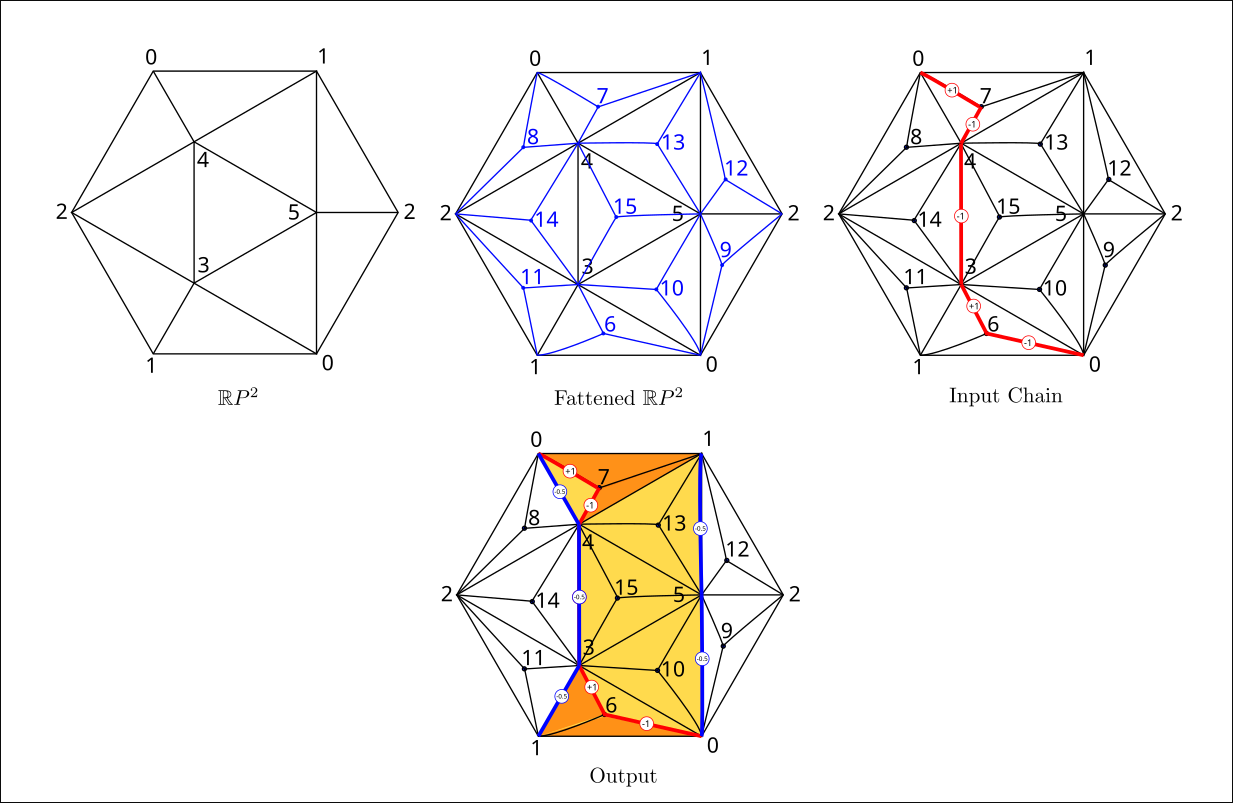
For the triangles (-values) in the output, the yellow triangles belong to the original and have a coefficient of . The orange triangles are protruding out of the along the created tetrahedra and have a coefficient of .
The above can be ignored, this is codimension 3.
However, I may have found something of interest. I took an instance which had several instances of , where is the basis matrix for an intermediate step. In each case, I computed the Smith normal form of and found they all had the following form:
where and . The values of and vary across intermediate bfs’s.
Consider the lattice generated by :
Consider then the cokernel, , which has index . From the above, it appears that our cokernel is of the form . I further claim (without real evidence) that this is a -group.
Recall that our bfs has integral solution if and only if . Let where . Then . Note that is unimodular, so if and only if . Thus, if and only if
Numerical experiments also suggest that
where is the last -rows of for every corresponding basis . However, upon checking it appears that
i.e., there exists some vector such that . However, there is no guarantee that if we start with such a right-hand side that the corresponding basis for would appear. This suggests that the LP’s polyhedra may not be integral for all .
Define
Then we know the set of inputs which give integral solutions contains the sublattice
but is likely much larger as not all basis are visited. That is,
After testing thousands of randomly generated minors, the property does not hold for every submatrix . However, I have yet to find a feasible basis in which the above property did not hold.