Full paper: https://webhomes.maths.ed.ac.uk/~v1ranick/papers/forman1.pdf
CW Complexes
The author works in the realm of CW complexes to keep the main results as general as possible. Below is a brief recap of CW complexes, more information can be found at Cell Complexes.
Let be the closed unit ball in -dimensional Euclidean space. The boundary of is the unit -sphere
Define a -cell as a topological space that is homeomorphic to . Let be a topological space, a -cell and a continuous map (more specifically the domain is the subset that is homeomorphic to ). Denote by the space where is the equivalence relation given by identifying each with . Intuitively, we are taking a -cell and gluing the entire boundary to .
A finite CW complex is the finite nested sequence
where each is the result of attaching a cell to . Let denote the free abelian group generated by the -cells of . Then there are boundary maps
such that and the exact sequence
gives the homology of , i.e.,
The Strong Morse Inequalities
Let be the number of -cells of . Denote the Betti numbers of by . Then for any
Consequently, we get the Weak Morse Inequalities:
The Basics of Discrete Morse Theory
Recall that a finite simplicial complex is given by a finite set of vertices along with a set of subsets of such that
- If and then .
We call the elements of simplices and the simiplicial complex. A -dimensional simplex, , has vertices and we denote its dimension by . We say that is a face of , denoted , if .
Discrete Morse Fucntion
A function is a discrete Morse function if for every , the following two properties hold:
- ; and
- .
We say a simplex is critical if both of these sets are empty, i.e.,
- ; and
- .
One may show, that for any simplex , at least one of the critical properties must hold.
A discrete Morse function provides a way to build the simplicial complex by attaching simplices in the order prescribed by the function. More specifically, by defining to be the subcomplex consisting of all simplices of such that along with all of their faces.
Lemma 2.6
If there are no critical simplices with , then is homotopy equivalent to .
In other words, the complex only changes when we add critical simplices. When we add non-critical simplices they collapse down to the same complex we had. This stems from a very general phenomenon. Suppose that are both simplicial complexes differing by two simplices, and where is a free face of , i.e., a face that is not the face of any other simplex in . Then one may deformation retract into , hence and are homotopy equivalent. This is known as simplicial collapse and denoted .
Lemma 2.7
If there is a single critical simplex with , then there is a map , where is the dimension of , such that is homotopy equivalent to .
That is, when we add a critical simplex to the complex, we get a new structure, , formed by attaching a -cell to the current complex, .
Gradient Vector Fields
Noncritical simplices occur in pairs. If an edge is not critical because it has a vertex, , of higher value, then it follows that is also not critical. Thus, we get a pairing, which we denote by an arrow . One may think of these arrows as pointing in the direction of simplicial collapse.
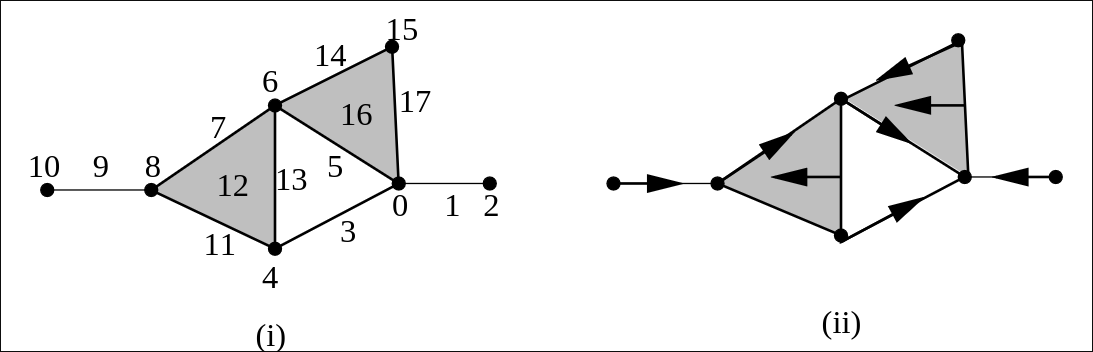
From this, we get that every simplex satisfies exactly one of the following properties:
- is the tail of exactly one arrow
- is the head of exactly one arrow
- is neither the head nor tail of an arrow (in which case it is critical)
This results in the following definition:
Discrete Vector Field
A discrete vector field on is a collection of pairs of simplices of such that each simplex is in at most one pair of .
Given a discrete vector field on , we form a -path by a sequence of simplices
such that and . If , we call the path a non-trivial closed path.
Theorem 3.4
Let be a gradient vector field of a discrete Morse function . Then a sequence of simplies is a -path if and only if for each , and
This result implies that a discrete vector field is the gradient vector field of a discrete Morse function if and only if there are no non-trivial closed -paths.
A Combinatorial Point of View
Consider the Hasse diagram (without the ) of a complex and let be a discrete vector field. We modify the Hasse diagram as follows: if then flip the orientation of edge so that it goes from . Then a -path is simply a directed path in the modified Hasse diagram. Note, that not all directed paths form -paths.
Thus, we may think of a discrete vector field as a partial matching of the Hasse diagram. Therefore, a discrete vector field is a gradient vector field if this partial matching is acyclic in our modified Hasse diagram.
Theorem 6.3
Let be an acyclic partial matching of the Hasse diagram of as described above. Let denote the number of unpaired -simplices. Then is homotopy equivalent to a CW-complex with exactly cells of dimension , for each .
As a special case, if is a complete matching then the complex is contractible.