Recall the repair ILP objective defined by
where
Recall that we found that
i.e.,
Notice then that
i.e., can be restricted to a hyperrectangle.
Proposition: Let be the optimal objective value to the LP relaxation of the flat norm and the objective value obtained by taking the ceiling of and recomputing . Then it follows that
Proof. Let and notice that . Moreover,
Therefore, it follows that
Theorem 1: If is totally bimodular, then the flat norm is solvable in strongly polynomial time.
Proof. According to Artmann et al., an ILP of the form is solveable in strongly polynomial time if every submatrix of has absolute determinant at most 2. Write with and set where . We can recover by . In order to ensure that , we need that . As a result, we can rewrite the flat norm ILP as
Denote by the constraint matrix, which has full column rank. Consider a submatrix by choosing rows of and rows of where and . We claim that
Indeed, proceed via induction on . If , then it follows that
for some . The result follows by expanding along rows of until we get a matrix. Consider then a submatrix of . Select any identity row to expand upon, resulting in a submatrix . Thus, it follows by the induction hypothesis that
A similar argument may be done on the columns of . Thus, we get that
Therefore, the flat norm is solveable in strongly polynomial time if is totally bimodular.
Question: Under what conditions can we ensure that is totally bimodular?
Quick Recap of Relative Homology
Consider a subcomplex of a simplicial complex . Then is the subgroup of consisting of chains that live in . We define the quotient chain group
which is the free abelian group generated by the -simplices of that are not in . Because , it follows that
forms a chain complex. Thus, we can define
to be the -th relative homology group of the pair . More concretely, a class in is represented by a chain with and is identified with if
for some and . The relative homology is directly related to reduced homology:
One may construct the short exact sequence
where is given by inclusion and is given by quotient. Using the snake lemma, this can be extended into a long exact sequence of homology groups:
The exact sequences are often used to determine the relative homology groups.
A commonly used result is that of excision. If such that is a subspace of , then
In simpler terms, if the closure of is contained in the interior of , then one may cut out without changing the relative homology.
Example: Consider with . Because is contractible we get that for all which gives that
Because this forms a short exact sequence, is an isomorphism. Hence
One particular area that may be use to use is with embeddings. Let be embeddable in by a continuous, injective map and let such that . Then there is an induced map and homomorphism such that the diagram below commutes:
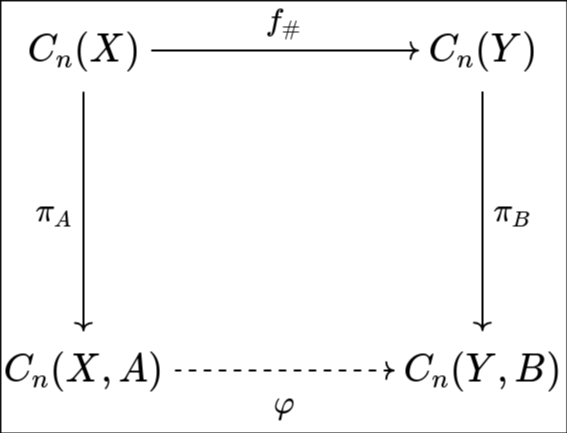
where and are the natural projections .
Relative Homology and Total Bimodularity
Let be a square submatrix of the boundary matrix with rows and columns . Then it follows that is the relative boundary matrix, i.e., if is the closure -simplices of and is the closure of the -faces of that are not in , then is the matrix representatation of
where .
We are thus interested in the homology
H_p(L,L_0) = \textup{Ker}(\partial_{p})/\textup{Im}(\partial_{p+1})=\Z^{m-r-s}\oplus\bigoplus_{i=1}^r\Z/\alpha_i $$where $m=|Z|$, $r=\textup{rank}(\partial_{p+1})$, $s=\textup{rank}(\partial_p)$ and $\alpha_1,\dots,\alpha_r$ are the invariant factors given by the Smith normal form of $\partial_{p+1}$. **Lemma 2:** $B=[\partial_{p+1}]$ is totally bimodular if and only if, for every pair of pure subcomplexes $L_0\subseteq L\subseteq K$ of dimensions $p$ and $p+1$, the torsion subgroup of $H_p(L,L_0)$ has order at most 2. *Proof.* ($\Rightarrow$): Consider an arbitrary pair $(L,L_0)$ and set $T=L^{(p+1)}$ and $Z=L^{(p)}\setminus L_0$. Then $H_p(L,L_0)$ has torsion of order\prod_{i=1}^r\alpha_i = d_r(\partial_{p+1}) = \textup{gcd}\{r\times r\text{ minors of $B[Z,T]$}\} \le 2.
|\det B[Z,T]|=\begin{cases}
	\prod_{i=1}^r\alpha_i & r=|Z| \\
	0 & r < |Z|.
\end{cases}
B[Z,T] = \begin{array}{c|ccc}
	& [a,d,e] & [a,b,e] & [b,c,e] & [c,e,f] & [c,d,f] & [a,d,f] \\ \hline
	[a,d] & 1 & 0 & 0 & 0 & 0 & 1 \\
	[a,e] & -1 & -1 & 0 & 0 & 0 & 0\\
	[b,e] & 0 & 1 & -1 & 0 & 0 & 0\\
	[c,e] & 0 & 0 & 1 & 1 & 0 & 0\\
	[c,f] & 0 & 0 & 0 & -1 & -1 & 0\\
	[d,f] & 0 & 0 & 0 & 0 & 1 & 1
\end{array}
B[Z,T] = \begin{bmatrix}
	B[Z_1,T_1] & 0 \\
	0 & B[Z_2,T_2]
\end{bmatrix} \Longrightarrow \det B[Z,T] = \pm4.
H_2(\R P^2)\rightarrow H_1(L\cap E)\xrightarrow{\varphi} H_1(L)\oplus H_1(E) \xrightarrow{\psi} H_1(\R P^2).
h:H_1(L)\oplus H_1(E)/\textup{im}\varphi\rightarrow H_1(\R P^2) = \Z/2\Z.
\begin{align*} i_(1,0) = \pm2~\text { and }~i_(0,1) = \pm 2. \end{align*}
So $\varphi(x,y)=(\pm2,\pm2,e)$ for some $e\in H_1(E)$. Consider then the map\pi:\Z\oplus\Z\oplus H_1(E)\rightarrow(\Z/2\Z)^2,~(a,b,e)\mapsto(a\bmod 2,b\bmod 2)
g:\Z\oplus\Z\oplus H_1(E)/\text{im}\varphi\rightarrow (\Z/2\Z)^2
0 = H_p(A\cap B, A_0\cap B_0)\rightarrow H_p(A,A_0)\oplus H_p(B,B_0)\rightarrow H_p(L,L_0)\rightarrow H_{p-1}(A\cap B,A_0\cap B_0)=0.
H_p(L,L_0) \cong H_p(A,A_0)\oplus H_p(B,B_0)\cong\Z/2\Z\oplus\Z/2\Z.