We know that the existence of two disjoint Mobius strip results in absolute determinant . We are unsure of the existence of two overlapping Mobius strips. Let’s explore which contains multiple overalapping Mobius strips, but is constructed form a single Mobius strip.
Below is the triangulation of we will look at:
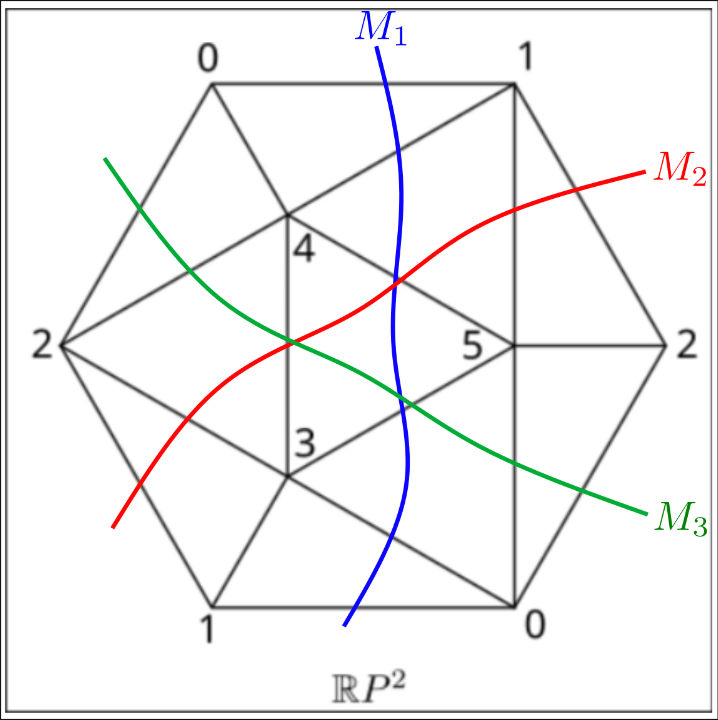
There are three Mobius strips:
We start by looking at the submatrix corresponding to .
All minors, where , have determinant 0 or .
Below is the full boundary matrix:
I wrote code (see below) which computed every minor for and found that all minors had absolute determinant at most 2, i.e., is totally bimodular!
m, n = A.shape
num_bad_minors = 0

for k in range(1, min(m, n) + 1):
    print("Testing all {}x{} minors...".format(k, k))
    for rows in combinations(range(m), k):
        for cols in combinations(range(n), k):
            submatrix = A[np.ix_(rows, cols)]
            det = np.linalg.det(submatrix)
            if np.abs(det) > 2:
                num_bad_minors += 1
                print("{}".format(det))

print("Found {} minors with absolute determinant greater than 2.".format(num_bad_minors))
Subdividing this triangulation causes the number of minors to blow up. Restricting to just two Mobius strips and including all triangles in our submatrix resulted in determiant 0, , or .
Theorem: Let be the boundary matrix for a triangulation of . Then every submatrix of has absolute determinant at most 2. Moreover, any square submatrix of has absolute determinant at most for some .
Proof. Let be a subcomplex of . The snake lemma gives that
is an exact sequence. Recall that
so
Because the sequence is exact, . Note that is induced by the inclusion so it follows that for a vertex , . Assume that we have two vertices and which get mapped to and in . Because is connected, it follows that there is a 1-chain such that in . In other words, implying that . Thus, every class in gets mapped to the same generator. This implies that which results in where is the number of connected components of . Hence, we can reduce our exact sequence to
Due to exactness at , it follows that . By the first isomorphism theorem,
We also have exactness at which implies that . So we can reduce our exact sequence further to
This sequence splits as is a free abelian group, thus it follows that
i.e., either is torsion free, or its only torsion subgroup is . Indeed, because it follows that is onto or is trivial. These two cases give and , respectively. Therefore, every minor, where is the number of columns, has absolute determinant at most 2.
Now let be a pair of pure subcomplexes of dimension 1 and 2, respectively. Let be the usual sphere construction where a point is identified with its antipodal point . Set and . Because , it follows that for some point . Since , it follows that is embeddable in . Thus it follows that must be torsion-free as the boundary map for any complex embedded in is TU. Notice that our map gives a lifted triangulation of . Define by
where and are the lifted triangles of . Then it follows that implying that induces a homomorphism . Because induces a map given by
it follows that
implying that where is induced by . Let be such that for some . Notice that
implying that is torsion in . But is torsion free, so we get that which implies that
Therefore, the torsion subgroup of is for some .